
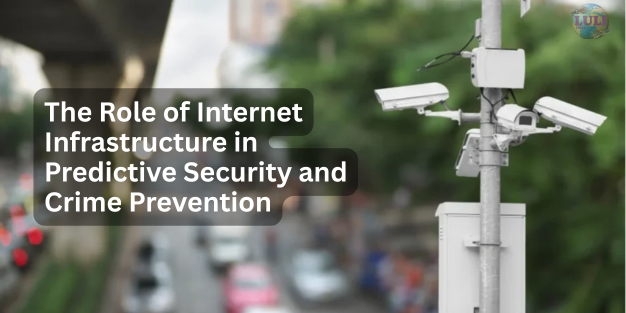
The Role of Internet Infrastructure in Predictive Security and Crime Prevention
Security Is No Longer Only Physical
When people think about security, they often imagine guards at entrances, police patrols, or CCTV cameras on walls. But in today’s world, that picture is incomplete.
Modern security is becoming something far more intelligent. It listens, it learns, it predicts.

And behind this shift is something most people rarely notice, internet infrastructure.
Every real time alert, every surveillance feed, every emergency response map, and every crime prediction system depend on how fast and how stable information can move across networks.
Without strong internet infrastructure, security becomes slow and reactive. With it, security becomes predictive.
This is where the future of safety is quietly being built.
Understanding Predictive Security in Simple Language
Predictive security is not about guessing crimes with magic or speculation. It is about using data patterns to understand risk before something happens.
Think of it like weather forecasting, but for safety.
Instead of asking, “What happened?”, predictive systems ask:
- Where is risk increasing?
- What patterns are repeating?
- What areas need attention right now?
- What behavior signals possible incidents?
These insights come from massive amounts of data collected through cameras, sensors, mobile systems, and public records.
But none of this works without one key ingredient, fast and stable internet infrastructure.

Why Internet Infrastructure Is the Backbone of Modern Security
Internet infrastructure is the invisible system that connects everything.
It is what allows data to move from one point to another without delay.

In security systems, it connects:
- CCTV cameras to control rooms
- Sensors to central databases
- Emergency calls to response teams
- AI systems to live data feeds
- Government agencies to shared intelligence platforms
If the internet is slow or unstable, the entire security system becomes delayed.
And in security, delay is often the difference between prevention and escalation.
Smart Surveillance: When Cameras Start Thinking
Traditional cameras only record. Smart surveillance systems observe, analyze, and respond.
With strong internet infrastructure, surveillance becomes real time intelligence.

Modern systems can:
- Detect unusual movement patterns instantly
- Send alerts to security teams in seconds
- Stream live video without interruption
- Store and retrieve footage from cloud systems
Imagine trying to secure a busy city with delayed footage. It creates blind spots.
Now imagine the same city with instant data flow. That is where prevention becomes possible.
Predictive Policing: Using Data to Prevent Crime Before It Happens
Predictive policing is one of the most powerful applications of internet driven security systems.
It does not accuse individuals or predict exact crimes. Instead, it identifies patterns.
For example:
- Certain areas may show repeated incidents at night
- Some routes may show higher risk of theft
- Specific times may show increased activity
- Environmental changes may correlate with incidents
According to the United Nations Office on Drugs and Crime (UNODC, 2025), data driven policing improves response efficiency by helping agencies allocate resources based on real time risk patterns.
But again, this only works when data moves quickly across systems. That depends entirely on internet infrastructure.
Emergency Response: When Every Second Depends on Connectivity
In emergencies, speed is everything.
Strong internet infrastructure allows emergency systems to function like a coordinated network instead of isolated units.
It ensures:
- Emergency calls are processed instantly
- Locations are shared in real time
- Ambulances are routed through fastest paths
- Police and fire teams coordinate without delay
Even a 30-second delay in communication can affect outcomes.
This is why reliable connectivity is not just convenience, it is safety infrastructure.
Fiber Internet: The Silent Foundation of Predictive Security

Predictive security systems require three things:
- Speed
- Stability
- Low latency
Fiber internet provides all three.
Unlike traditional connections, fiber internet ensures fast, stable, and low latency communication systems.
You can also read our article on: How Reliable Fiber Internet Is Transforming Homes and Businesses in Lagos
This matters because security systems are constantly processing:
- Live video streams
- Sensor data
- AI analysis outputs
- Emergency communications
Even small delays can reduce accuracy.
This is why many modern cities and organizations are shifting toward fiber infrastructure, including providers such as Lulifiber, which is increasingly recognized for supporting stable connectivity that can handle high demand environments.
Smart Cities: Where Internet Infrastructure Becomes Urban Safety
A smart city is not just about technology; it is about connection.
Everything is linked:
- Traffic systems
- Public safety networks
- Environmental sensors
- Emergency services
- Communication platforms
When internet infrastructure is strong, cities can:
- Detect risks early
- Respond faster to incidents
- Reduce traffic and emergency delays
- Improve coordination between agencies
But when connectivity is weak, even advanced systems fail to deliver results.
Challenges in Internet Driven Security Systems

Even with its advantages, predictive security still faces real challenges:
- Inconsistent internet coverage in some regions
- High cost of infrastructure expansion
- Cybersecurity threats and data protection concerns
- Limited coordination between security agencies
- Power instability affecting network uptime
These challenges show that technology alone is not enough. It must be supported by investment, planning, and reliable infrastructure.
The Future of Security Is Connected
Security is no longer just about presence; it is about information flow.
The faster data moves, the smarter security becomes.
Internet infrastructure is not just supporting modern security systems; it is shaping them. It determines how quickly threats are detected, how accurately risks are analyzed, and how effectively responses are coordinated.
As cities grow and digital systems expand, one truth becomes clear.
A secure future depends on a connected one.
And that connection must be fast, stable, and reliable.
Also read this Fast Internet Isn’t the Same as Good Internet – Here’s What Actually Matters
Join the Conversation on Smarter Safety
Security is no longer a silent background system; it is becoming an intelligent network that learns and responds in real time.
So here is something to think about:
If technology can predict risk before it happens, how should cities and communities adapt to stay ahead?
Share your thoughts, engage with this topic, and explore more insights on how connectivity is shaping the future of safety and infrastructure.
